I am the feral, tender one. When coming back to the body after a disturbance in the mind, I find myself writing about dreams and desires, monsters and mermaids, serpents and sisters. They are the fairy tales that – in their telling – have pulled me back to a sense of purpose after an episode of mania or melancholia. But over the past year, I felt myself losing heart in these things. That is a sad thing to write, and a sad thing to read back. It is a darkening, an inward wintering in the seasons of the self, from which I will now try to reach out in the words that follow.
“Losing heart” has felt like more than an expression; at times, it seems as though my heart has truly been shrinking inside of me.There are the tangential phrases of “losing faith” and “losing touch.” Juliet Capulet says that “palm to palm is holy palmer’s kiss,” and our bodies can experience the physical ache from a separation of skin – lovers who untangle their limbs and their lives when they leave or are left. To “lose contact” makes me think of a satellite spinning out past the point of being reachable. Sometimes we are simply sending signals that can’t quite cross the distance we had hoped upon launch. Sometimes the wanderer we are trying to reach is a dismembered part of ourselves, lost out in space.
This is an article about losing heart – a “hearticle,” if you will. And I certainly will, because playing around with words makes a sad thing easier to write about.
Each year I set an intention for exploration, and 2025 was my year of faith. I write about this practice as though it is a long-held tradition, but it was only my second year of following through on the concept. This alternative to a New Year’s resolution started in 2024 with my year of boundaries. Towards the end of it, two of my closest friends sat me down and said I had gone too far with said boundary-making, so I had to smooth the edges of my overshoot. In Goblin Market, Rossetti wrote that a sibling will “fetch one if one goes astray.” These fetchers can be the ones you are born with, or the ones you grow with in the garden of a second childhood.
For 2025, Our Lady of Faith, I set out with the goal of making a conscious and concerted effort to separate myself from the religion of disorder and disease. Faith is often tied to religion, and even though I have followed addictions like the rules of religion, I haven’t truly harboured faith in them. This distinction is something I am trying to unpick, and I don’t mean to paint religion with a bad brush in the process – although there are religions that would paint me with one. It is a human tendency to commune in search of comfort, and in my experience anything can become a religion under the right conditions of yearning. Just like I seem to be able to use anything as a drug when I’m desperate enough. Atta girl.
To go against one way of life provoked a spike in my symptoms (punishment for sacrilege?) which felt like a counter-attack in my pursuit of healing and wholeness. Although this can be expected in any form of recovery, it doesn’t make the fight easy, or even fair. Hence the need to investigate my relationship with faith in practice, unattached to the dogma demanded of me, by me. I was interested in rebuilding the foundations of my life around a Pagan orthopraxy rather than an orthodoxy. This spiritual way of thinking is less concerned with what one believes in, and more with how we treat ourselves, our community, and our world. As Carl Jung observed, in moments of self-reckoning we “don’t so much solve our problems as we outgrow them. We add capacities and experiences that eventually make us bigger than the problems.”
As I tried to redirect my attention, what I didn’t expect – perhaps foolishly on my part – was that the more I worked to separate myself from the lesser life I felt trapped by, the more my insides hollowed out. This sensation corkscrewed through me in all the places I had stuffed up, cloth in the cracks; now wrung out, hung out, and me at the centre, humbled by the physical feeling of emptiness. It is a widely held opinion that self-harm is a pleading with death, when really it can be an act that keeps a lot of us grounded and alive, until it doesn’t. It is effective for coping, until it isn’t. These twisted things make a twisted life bearable, for a time. By giving them up, the floor gave way beneath me, and I had to freefall into the void.
When I started writing this hearticle (the mood was getting low again, so I am deploying the portmanteau as a pick-me-up), I didn’t think I would be detailing these aspects of my life. Then again, I don’t know how else I am to get to the heart of my losing heart – feelings within feelings. There is a burrowing that happens at this point in the seasons, and the idea of feelings as Russian dolls tucked away inside one another is articulated in the opening line of a Tracey Emin poem: “I seek a lover, a lover who wreaks havoc with my heart, a life within a life.” I have been that lover. I have clung fast to all that has hurt the integrity of my being, and called it intimacy. These acts crystallise in moments of crisis, and embody one who will not leave me because I cannot leave them. It becomes a secretive existence, and the longer you keep the secret, the more you are seduced by the sadist in yourself. The more I have been infantilised by the magnificence of the damage that can be done.
All of this is to say, I think I can partly attribute my losing heart to the giving up of things that were keeping my heart buoyant in its beating. Smoking areas have been holding pens; lunch breaks have been liferafts; bathroom tiles have cradled me cold in the heat of a heightened moment. It is uncomfortable to recognise and honour the times that have felt so damnably lonely. At the start of a new chapter, the instinct can be to disown the past, and my urge is to abandon the abandonment I have felt – give it a taste of its own medicine. In Bluets, Maggie Nelson says that “loneliness is solitude with a problem,” and I have not made a sanctuary of my solitude in adulthood. Not yet.
When I was a child, I had an obsession with windowsills. If I try to imagine my heart in girlhood, it appears in two forms. One is rolling moors of wild heather, suffused with the mud and blood of adventure, and the other unfoldment is a wide-open windowsill, for huddling on and softening against the silver night. Was that not a sanctuary? For so long I forgot the feeling of taking joy in myself. In Bluets, Nelson goes on to say that “to wish to forget how much you loved someone – and then, to actually forget – can feel, at times, like the slaughter of a beautiful bird who chose, by nothing short of grace, to make a habitat of your heart.” I do not wish to misplace that girl I loved. Not in the sodden or the shrunken of this current landscape.
When we cry, we shed. Each year the trees redden, and now, as I write, not only the willow has wept itself free. I spent the autumn making lists. Lots of lists. Reminders of the things that I used to enjoy: the books and poems I memorised, the movies I worshipped, the walking routes I rambled along… Even reminders of the things that are more rudimentary: breathing properly, washing myself, changing my clothes. Carrying out the most mundane of tasks can feel insurmountable, but they end up doing good by putting a belief system into practice – that we are worthy of care and stability. In all of this, I am trying to buy myself time so that the spirit can do its work, and in the process I am having a romance with myself, finding that there is an art to the muddling through of the everyday. Though not much lauded by the outside looking in, the people who love us will value these things. Just as I drew the distinction between religion and faith, here I want to discern between validation and valuation.
The 1939 film The Wizard of Oz brought me wonder in childhood, and so it found its way onto one of my lists. When the Wizard is asked to produce a heart for the Tin Man, he remarks that “hearts will never be practical until they can be made unbreakable.” To have something means we could lose it. To lose something means a process of mourning, if it is truly gone, and effort if we want to get it back. Nothing is promised – not even ourselves to ourselves – and that is why we must fight for what is possible. The future we long for will not arrive of its own accord; it must be beckoned. And though hearts are impractical in many ways, by keeping us alive they allow us to love. That is the creational energy I am choosing, despite the risk of my own human fragility.
I don’t know if I started writing this hearticle (third offence) thinking I could draw a shape in the surrounding darkness of my disturbances – something to corner and catch at. Maybe writing this was simply a way to outlast another day without giving in to all of the things I am giving away. Maybe faith is the underlying energy of endurance that sees us through the heart swells and heart sores. In losing heart last year, I found new faith, and like an animal going to ground, I am licking my wounds and listening to my palpitations. My heart wants me to pay attention to the truth of my pain, and to soothe it into a renewed rhythm. Rock the baby, raise the baby. She is me, and this is our year of release.
A while ago I wrote a song that I have yet to do anything with in my band or as a solo venture. I feel the time is soon to come, for the lyrics go like this:
I am my mother’s hardy girl
Pick up the pen each time we writhe
Confusion calling out
In sickness striving
How to heal a hungry heart?
Feed it often, feed it good
Do as you shall
Not as you’re told you should
Georgia Williams
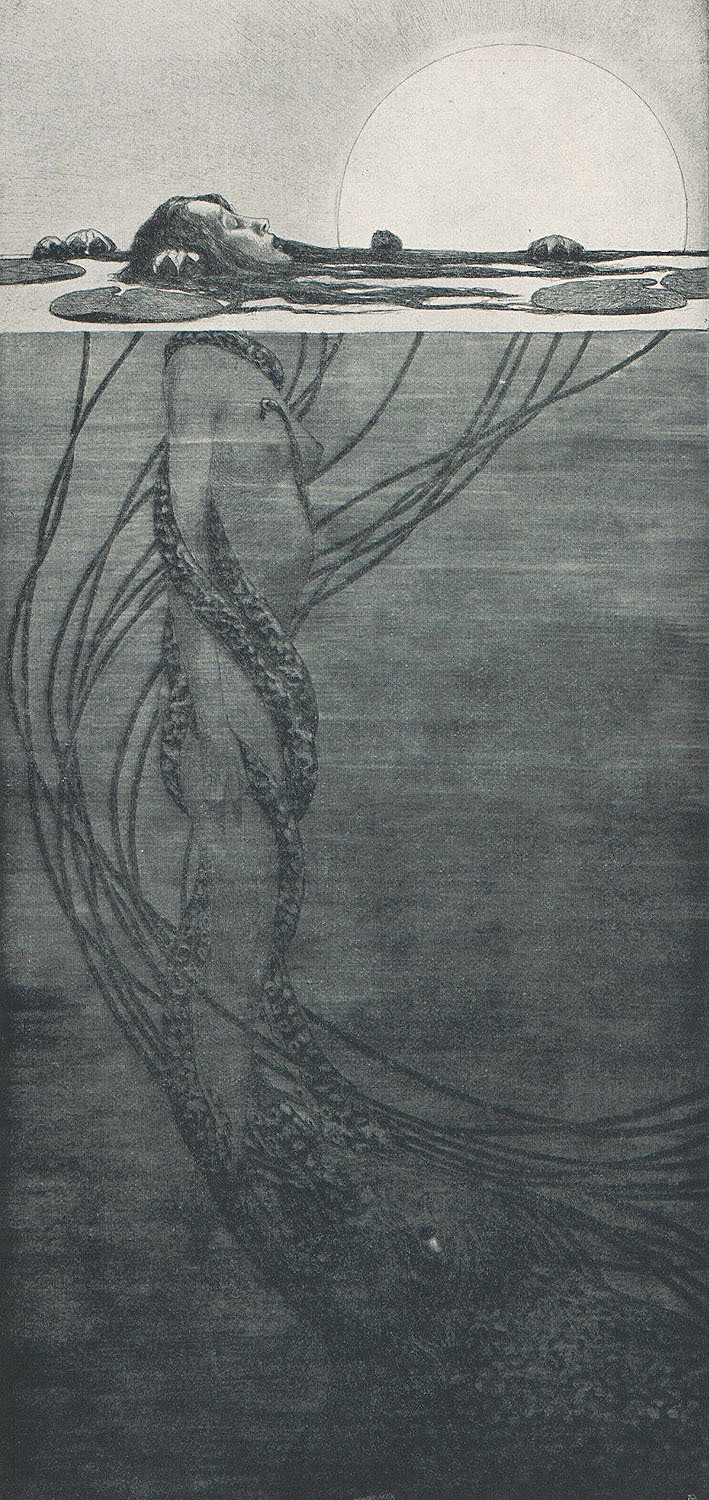
Artwork – ‘Art and Mammon’, Jugend ~ Fritz Hegenbart (Austrian, 1864-1943) [1902]
The beautiful naiad struggles to breathe in the light of day. The monstrous, greedy Mammon entwines her, attempting to drag her to his dark, watery lair.
 Marezine